
Poem: Sunrise Over Worcester
5 Questions About: Jason Pinter
12 Signs That You Might Be A Banker
The 9 Worst Movies to Win Oscars
Book Review: Narrow Miss for "Above the Law"
5 Questions About: Screaming Blue Messiahs
What's Up With All the Fat, Naked Guys?
Thoughts from the Shadows: The Craziness of Publis...
How to Make a Damn Good Horror Movie
Literary Criticism
Fantastically Bad Cinema
Essays
Under God's Right Arm
June 2006
July 2006
August 2006
September 2006
October 2006
November 2006
December 2006
January 2007
February 2007
March 2007
April 2007
May 2007
June 2007
July 2007
August 2007
September 2007
October 2007
November 2007
December 2007
January 2008
February 2008
March 2008
April 2008
May 2008
June 2008
July 2008
August 2008
September 2008
October 2008
November 2008
December 2008
January 2009
February 2009
March 2009
Alcoholic Poet
Baby Got Books
Beaman's World
BiblioAddict
Biblio Brat
Bill Crider's Pop Cultural Magazine
The Bleeding Tree
Blog Cabins: Movie Reviews
A Book Blogger's Diary
BookClover
Bookgasm
Bookgirl's Nightstand
Books I Done Read
Book Stack
The Book Trib
Cold Hard Football Facts
Creator of Circumstance
D-Movie Critic
The Dark Phantom Review
The Dark Sublime
Darque Reviews
Dave's Movie Reviews
Dane of War
David H. Schleicher
Devourer of Books
A Dribble of Ink
The Drunken Severed Head
Editorial Ass
Emerging Emma
Enter the Octopus
Fatally Yours
Flickhead
The Genre Files
The Gravel Pit
Gravetapping
Hello! Yoshi
HighTalk
Highway 62
The Horrors Of It All
In No Particular Order
It's A Blog Eat Blog World
Killer Kittens From Beyond the Grave
The Lair of the Evil DM
Loose Leafs From a Commonplace
Lost in the Frame
Little Black Duck
Madam Miaow Says
McSweeney's
Metaxucafe
Mike Snider on Poetry
The Millions
Moon in the Gutter
New Movie Cynics Reviews
Naked Without Books
A Newbie's Guide to Publishing
New & Improved Ed Gorman
9 to 5 Poet
No Smoking in the Skull Cave
Orpheus Sings the Guitar Electric
Polly Frost's Blog
Pop Sensation
Raincoaster
R.A. Salvatore
Reading is My Superpower
Richard Gibson
SciFi Chick
She Is Too Fond Of Books
The Short Review
Small Crimes
So Many Books
The Soulless Machine Review
Sunset Gun
That Shakesperherian Rag
Thorne's World
The Toasted Scrimitar
This Distracted Globe
Tomb It May Concern
2 Blowhards
Under God's Right Arm
A Variety of Words
The Vault of Horrr
Ward 6
When the Dead Walk the Earth
The World in the Satin Bag
Zoe's Fantasy
Zombo's Closet of Horror
Bookaholic Blogring
Power By Ringsurf
An Interview with Media Observer and Journalist Dan Kennedy
(Dan Kennedy, an assistant professor at Northeastern University School of Journalism, publishes a blog called Media Nation. It analyzes media coverage – especially around political coverage. He’s got the eye of a journalist, probably because he does that, too. He writes a column for the Guardian (U.K.) and articles for CommonWealth Magazine and the Boston Phoenix (where for many years he was media columnist). He is also a regular on Boston area radio and WGBH-TV’s “Beat the Press.” DaRK PaRTY wanted Dan’s insight on the presidential race, how it was being covered by the mainstream press, and any wry observations he was willing to make about the Obama and McCain campaign machines. We struck gold!)

DaRK PaRTY: What is your assessment of the overall media coverage during this year's presidential race?
Dan: I’m willing to admit I'm an elitist, and I spend most of my time with elite media such as the New York Times and NPR. I think they've done a reasonably sophisticated job, although they're too timid to take on the broader narrative.
I would describe that broader narrative as the descent of our politics into a sort of insanity during the Bush years with regard to the White House's hyper-aggressive approach to foreign policy, the embrace of torture, domestic spying, radical capitalism (helping to foment the current meltdown), and an anti-scientific orientation informed by the most primitive forms of religious belief.
The general-election campaign has been defined by the decision of John McCain, a modern and worldly man, to embrace this insanity just as it is beginning (I hope) to pass from the scene.
DP: The Republicans have been crying foul over the media's treatment of Sarah Palin. What's your take?
Dan: The media have been far too kind to Sarah Palin, who is an exemplar of the most dangerous strands in our politics, as I explained in my earlier answer. We have all seen the video of her urging church-goers literally to pray that God will facilitate the construction of a natural-gas pipeline in Alaska. For that reason alone, I would not vote for her. And I'm not even getting into whether she agrees with the pastor of her former church, who said -- while she stood nearby, listening and applauding -- that Alaska holds a special place in God's plans for the post-Apocalyptic world. Scary stuff.
But there are many more reasons to be appalled by Palin, such as her lies about Troopergate, her non-existent opposition to the "Bridge to Nowhere," and her family's involvement in the radical, anti-American Alaskan Independence Party; her narrow-minded, vindictive approach to governing, documented by the Times, The New Republic, and numerous other news outlets; and her hate-filled, false rants against Barack Obama, which have had the effect of stirring up something close to mob hysteria. All these things mark her as someone who is profoundly unqualified to serve in any elected office, including the mayoralty of Wasilla, Alaska.
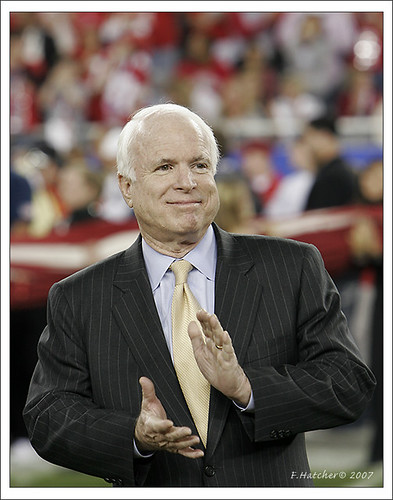
DP: If John McCain loses the election in November -- how much of it is because he picked Palin? What's been her effect on the McCain campaign?
Dan: My suspicion, though I can't prove this, is that Palin has hurt McCain more because of the opportunity cost involved in choosing her rather than in any specific thing she has said or done.
Imagine, if you will, the difference if McCain had chosen Mitt Romney as his running mate just before the financial meltdown began. Romney would be front and center, utterly credible and believable because of his successful business background.
It must be killing McCain that he has to hide his running mate from public scrutiny when he could have had one who would shore him up in an area where he is perceived as weak.
DP: Does Obama get better treatment in the press or is this another myth of the "liberal" media?
Dan: The answer to that is very complicated. The media have been notably tough on McCain for the miserable, negative campaign he's run; yet I still don't think they've quite gotten at how bad it's actually been. The media also have a longstanding love affair with McCain, and I think we've only seen that partially diminished this year.
Are the media in love with Obama? I don't know. During the primaries, I think he may have benefited from the media's well-established loathing for the Clintons, and there's no question that some in the media have swooned over the notion of a charismatic African-American presidential candidate.
We know from studies over the years that most elite political journalists are liberals. But the way those liberal journalists make their bones is by kicking the hell out of liberal politicians -- just ask Al Gore and John Kerry. That dynamic may be less at play this time because of disgust over the Bush years and the promise of something new represented by Obama.
DP: What is your assessment of the strengths and weaknesses of the two campaigns?

Dan: That's a difficult question, isn't it? Obama has run a remarkably competent and disciplined campaign. Just a few weeks ago I thought he might deserve criticism for not fighting back as hard as he should. But by maintaining an even keel, he's put himself in a commanding position in the polls with just a few weeks to go. I don't think McCain is out of it by any stretch of the imagination, but right now it appears that Obama is winning by a lot. He is also principled, intelligent, and, despite his lack of experience, dauntingly well-informed on a vast array of national and international issues.
Obama's life experience, which is so unusual and interesting, does lead him to come off as somewhat distanced from others, which has caused some backlash against him. Then again, Republicans always enjoy some success casting the Democratic candidate as "elitist" and "aloof," so I don't want to get carried away with that.
McCain's great strengths are his moral courage, as exemplified by his POW experience, and his willingness to stand up to his own party on such issues as torture, immigration, judicial appointments, and campaign-finance reform.
By turning himself into a conventional Republican, and by choosing Palin as a sop to the right-wing base, McCain managed to fritter away most of those strengths. He has come off as erratic (to use Obama's word) and angry. That should be deadly on Election Day, but I'm not going to make any predictions here. OK, I'll make one: Despite what the polls say today, the final result will be close.
An Interview with Dan Kennedy about his book on Dwarfism
Under God's Right Arm: Jesus Would Vote for Sarah Palin
Blame the #$@% Media!
Labels: 5 Questions, Dan Kennedy, Media, Politics, Presidents
 StumbleUpon |
 Digg |
 del.icio.us |
 Reddit |
 Technorati |
 E-mail

 (Dan Kennedy is a Visiting Assistant Professor of Journalism at
 DaRK PaRTY: What was your initial reaction when your daughter, Rebecca, was diagnosed with Achondroplasia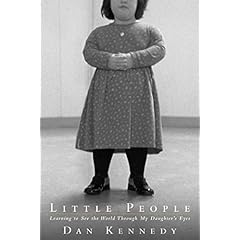 , one of the most common causes of dwarfism?
Dan: Dwarfism is not something we would have chosen for Becky, but I don't recall it as being particularly traumatic or depressing -- surprising, certainly.
I don't think we really came to terms with her dwarfism until she was five months old and nearly died of what for anyone else would have been nothing more than a bad cold. We learned she would need a tracheotomy and oxygen until her airways and rib cage had had a chance to grow.
For two years, our home was a blur of home nurses, medical equipment, and frequent trips to the hospital. That's when we really started to educate ourselves, as we realized that what we didn't know could kill our daughter.
Dan: That's a hard question, because Becky's dwarfism has not presented any huge challenges to us. As I said, she had a trach for two years when she was a baby. She has some hearing loss, which in turn led to a learning disability. These are the issues we've had to deal with -- not her short stature per se.
I'm not sure why, but the horror stories that we've heard from other parents haven't hit us -- at least not yet. Sometimes people stare at her, but she seems not to notice. I've never heard anyone yell the "M"-word ("midget") at her. She has a small circle of friends who accept her for who she is.
Becky's 14, and starts high school next fall. So perhaps the biggest challenges are yet to come.
DP: In your book "Little People," you explore dwarf sub-culture. Can you give DaRK PaRTY readers a brief synopsis of that culture?
Dan: I can't talk about "the" dwarf culture; it's different for everyone. But Little People of America, the largest organization in the United States for dwarfs and their families, is at the center of whatever sort of organized dwarf culture there is.
In many cases, parents start bringing their dwarf children to LPA events when they're babies. Regional and national conferences provide dating opportunities for dwarf teenagers. Many times, the teens will drift away until they want to find a mate, at which point they return. And, increasingly, dwarf couples themselves become parents, beginning the cycle all over again.
I've seen estimates that, at any given time, LPA is reaching about 10 percent of the dwarf community. That may not sound like much, but if you take into account the numbers of people who drift in and out depending on what's going on in their lives, then I'm sure it's much higher than 10 percent.
A couple of observations --
First, as the dwarf community -- particularly LPA -- has become politicized, we've seen the rise of something that might be called "dwarf pride." This encompasses such things as terminology ("little people" and, increasingly, "dwarf" are acceptable; "midget" is not), the rejection of limb-lengthening
surgery as a negation of identity, and cooperation with other disability groups on common goals regarding access and equal opportunity.
Second, there is a hierarchy within the dwarf community as there is within any community. People with achondroplasia -- the most numerous and, generally, the healthiest -- can sometimes seem to place themselves above those with rarer, more disabling conditions, such as diastrophic dysplasia and SED.
I don't want to make too much of this -- in fact, some of LPA's top leaders over the years have had conditions other than achondroplasia. And consider the Roloffs, the stars of TLC's "Little People, Big World" -- Amy has achondroplasia and Matt, a past LPA president, has diastrophic dysplasia.
Still, within LPA, there is a perception that someone with an exotic, more disabling form of dwarfism is not going to be welcomed quite as readily as a healthy, attractive young person with achondroplasia.
DP: Your daughter is now 14 years old. There must be a new set of challenges for her as she enters adolescence, high school and the dating scene. How has she handled this period of her life so far?
Dan: One of the first things we learned after Becky's dwarfism was diagnosed was that kids with disabilities or any kind of profound physical difference tend to spend more time with adults than they do with other children.
That has certainly been true in Becky's case. She's got a couple of good friends, but she seems to have little interest in being part of any larger social circle. She's also surprisingly oblivious to what's going on around her.
Becky's involved in Girl Scouts, and in theater and creative writing. There are times when it seems like she exists in a bubble -- in her own alternate reality. I don't think it would be a bad thing if she could go right through high school like that. Adults with dwarfism have told us that adolescence was an incredibly painful time in their lives, but that things started looking up once they went to college.
DP: What is the biggest misconception people have about dwarfism?
Dan: That's a good question, and I'm not sure what the answer is, except that I suspect people have fewer misconceptions today than they did in years past. Shows such as "Little People, Big World," actors and actresses such as Peter Dinklage and Meredith Eaton, and a number of documentaries that have been broadcast over the past decade or so have done a lot to demonstrate that little people are no different from any one else, other than being very short and having a few unique though treatable health problems.
Years ago, some people might have assumed that dwarfs were mentally retarded, or that they didn't live as long as those of us who are average-size. You were also more likely to encounter someone with dwarfism in a freak show or in a degrading movie or TV program than you are today. We also live at a time when people at least pay lip service to diversity. It may still be difficult to be disabled, gay or lesbian, or part of a racial or religious minority, but certainly it's less difficult now than it's ever been.
Given that, I'm not sure what ongoing misconception people might have about dwarfs. What strikes me as perversely ironic is that this acceptance comes at a time when we're on the brink of being able to eliminate, through genetic engineering, dwarfism and all kinds of disabilities and differences.
We may embrace diversity, but we also fear it -- and I suspect we'd eliminate it if we could. Soon science will give us the tools to do exactly that. And something important will have been lost.
Read our interview about Dorothy Parker here
Labels: 5 Questions, Dan Kennedy, Dwarfism
StumbleUpon |
Digg |
del.icio.us |
Reddit |
Technorati |
E-mail

 RSS Feed
]saddlebrown]tan]maroon](],](])us.st11.yimg.com/us.st.yimg.com/I/getfishy_1912_2002960]Fishboy]black],]1]10]3]1]1]1]1]1]1]1]1]1],](](]papayawhip])])]DaRK^20PaRTY^20ReVIEW]^3A^3ALiterate^20Blather^3A^3A],](](],](]maroon](](](]brown](],](]maroon](](](],]60]10],](](]^23F5ECE1])])]maroon]0.5]0],](](]^23F5ECE1])])]maroon]^23F5ECE1])])]^23666]16]maroon]maroon],](](]maroon](],](]^23333]^238C4614]tan],](](]^23F5ECE1])])],](](]^23F5ECE1])])],](](]^23F5ECE1])])],](]maroon]maroon]15]3]23]18]maroon],](](],](],](](],](]black](](](],](](](],]black](](](],](](]^23333](](](](](],]^2336F]^23333](],](]Posted^20by^20^24AUTH^20at^20^24TIME.]36],](](]black])])]^23F5ECE1])])]^23666]16]maroon]maroon],](](]maroon](],](]^23333]^238C4614]tan]Contributors]]]^24PROFILE]]]DaRK^20PaRTY^20LiNKS]]]The^20Ambrose^20Bierce^20Site])donswaim.com/]Ambrose^20Bierce]Ironic^20Times])www.ironictimes.com/index.html]Ironic^20Times]Gallery^20Voyer])www.voy-art.com/]Gallery^20Voyer]Tintinologist])www.tintinologist.org/]Tintin]Arcanum^20Cafe])www.arcanumcafe.com/]Arcanum^20Cafe]LADA^20-^20Protect^20our^20Kids])da.co.la.ca.us/pok/poklist.htm]POK^20List]Tom^20Caron^20-^20Boston.com])www.boston.com/sports/nesn/aboutus/onair/tomcaron/]TC]The^20Captain^20Humphreys^20Project])www.captainhumphreys.com/]Captain^20Humphreys]Torpedo^20Design])www.torpedodesign.com/]Torpedo^20Design]^3Cimg^20src^3D^22)us.st11.yimg.com/us.st.yimg.com/I/getfishy_1912_2002960^22^20alt^3D^22Fishboy^22^20style^3D^22border^3A^201px^20none^20black^3B^22^20/^3E])www.fishboy.com/]Fishboy]Etc]]]^3Cimg^20src^3D^22)psyc.horm.org/barimg/bar_psycho.png^22^20width^3D^2280^22^20height^3D^2215^22^20alt^3D^22PsycHo^3A^20Free^20Template^20Generator^22^20style^3D^22border^3A^200px^20solid^20black^22^20/^3E]^24PSYCHO]PsycHo^3A^20Free^20Template^20Generator]^3Cimg^20src^3D^22)psyc.horm.org/barimg/bar_firefox.png^22^20width^3D^2280^22^20height^3D^2215^22^20alt^3D^22Get^20FireFox^21^22^20style^3D^22border^3A^200px^20solid^20black^22^20/^3E])www.mozilla.org/products/firefox/]Get^20Firefox^21]^3Cimg^20src^3D^22)psyc.horm.org/barimg/bar_xhtml.png^22^20width^3D^2280^22^20height^3D^2215^22^20alt^3D^22XHTML^20Validator^22^20style^3D^22border^3A^200px^20solid^20black^22^20/^3E])validator.w3.org/check/referer]XHTML^20Validator]Recent^20Posts]]]^24RECENT]^20]]Archive]]]^24ARCHIVE]^20]]ADVERTISEMENTS]]]^20]]^26^2361470^3BPsycHo})


This work is licensed under a Creative Commons Attribution-No Derivative Works 3.0 License.
The Template is generated via PsycHo and is Licensed.