
Poem: Sunrise Over Worcester
5 Questions About: Jason Pinter
12 Signs That You Might Be A Banker
The 9 Worst Movies to Win Oscars
Book Review: Narrow Miss for "Above the Law"
5 Questions About: Screaming Blue Messiahs
What's Up With All the Fat, Naked Guys?
Thoughts from the Shadows: The Craziness of Publis...
How to Make a Damn Good Horror Movie
Literary Criticism
Fantastically Bad Cinema
Essays
Under God's Right Arm
June 2006
July 2006
August 2006
September 2006
October 2006
November 2006
December 2006
January 2007
February 2007
March 2007
April 2007
May 2007
June 2007
July 2007
August 2007
September 2007
October 2007
November 2007
December 2007
January 2008
February 2008
March 2008
April 2008
May 2008
June 2008
July 2008
August 2008
September 2008
October 2008
November 2008
December 2008
January 2009
February 2009
March 2009
Alcoholic Poet
Baby Got Books
Beaman's World
BiblioAddict
Biblio Brat
Bill Crider's Pop Cultural Magazine
The Bleeding Tree
Blog Cabins: Movie Reviews
A Book Blogger's Diary
BookClover
Bookgasm
Bookgirl's Nightstand
Books I Done Read
Book Stack
The Book Trib
Cold Hard Football Facts
Creator of Circumstance
D-Movie Critic
The Dark Phantom Review
The Dark Sublime
Darque Reviews
Dave's Movie Reviews
Dane of War
David H. Schleicher
Devourer of Books
A Dribble of Ink
The Drunken Severed Head
Editorial Ass
Emerging Emma
Enter the Octopus
Fatally Yours
Flickhead
The Genre Files
The Gravel Pit
Gravetapping
Hello! Yoshi
HighTalk
Highway 62
The Horrors Of It All
In No Particular Order
It's A Blog Eat Blog World
Killer Kittens From Beyond the Grave
The Lair of the Evil DM
Loose Leafs From a Commonplace
Lost in the Frame
Little Black Duck
Madam Miaow Says
McSweeney's
Metaxucafe
Mike Snider on Poetry
The Millions
Moon in the Gutter
New Movie Cynics Reviews
Naked Without Books
A Newbie's Guide to Publishing
New & Improved Ed Gorman
9 to 5 Poet
No Smoking in the Skull Cave
Orpheus Sings the Guitar Electric
Polly Frost's Blog
Pop Sensation
Raincoaster
R.A. Salvatore
Reading is My Superpower
Richard Gibson
SciFi Chick
She Is Too Fond Of Books
The Short Review
Small Crimes
So Many Books
The Soulless Machine Review
Sunset Gun
That Shakesperherian Rag
Thorne's World
The Toasted Scrimitar
This Distracted Globe
Tomb It May Concern
2 Blowhards
Under God's Right Arm
A Variety of Words
The Vault of Horrr
Ward 6
When the Dead Walk the Earth
The World in the Satin Bag
Zoe's Fantasy
Zombo's Closet of Horror
Bookaholic Blogring
Power By Ringsurf
No More Sledding, Bike Helmets, and the End of Outdoor Play Spells Bad News for Children
 There is a movement afoot in Massachusetts and other snowy states to ban sledding. A rash of sledding injuries in the state and the death of two girls in upstate New York have many municipalities in the Bay State on the verge of banning sledding at several locations.
“There are no brakes on a sled,” a state representative in Massachusetts told the Boston Globe.
No way! No brakes? But isn’t that what make sledding fun? It’s the thrill of hurtling down a hill and possibly taking a spill.
Welcome to the 21st century, kids, where your parents are in the process of ruining your childhood. Sledding bans are already in place in parts of New York, Missouri and Ohio.
Blame the Baby Boomers. Blame our litigation happy society. Blame the media.
We are living in a society where we want to regulate any danger – perceived or real – out of our children’s lives. It’s not possible, of course, but we’re trying anyway. As a result – in the name of “safety” we’re ruining the concept of free play. We’re taking the impulsiveness, the liberty, and the natural reckless out of childhood.
Let’s look at further evidence.
Bicycle Helmet Laws

Children in 37 states are now required by law to wear helmets when they ride their bicycles, including, I might add, tricycles. Bicycle helmet laws were first enacted in California back in 1987.
Advocates have pushed for the laws because they say helmets save lives. But only 700 people where killed in bicycle accidents in 2007 (up from the 662 killed in 2002 when there were fewer bike helmet laws).
This is a microscopic percentage considering that it is estimated that there are between 73 and 83 million bike riders in the U.S. What is your chance of dying in a bike accident on any given day? Less than 0.0009 percent.
The U.S. National Highway Traffic Safety Administration, which support bike helmet laws, is fond of reporting facts like this: “More than 47,000 bicyclists have died in traffic crashes in the United States since 1932.” But there’s no indication how many would have survived if they had been wearing helmets.
The result of these laws, of course, is the loss of childhood impulse to jump on your bike and ride.
The Demise of Outdoor Play
When was the last time you were forced to slow your car on a suburban street because a large group of boys were playing street hockey or touch football? I know the answer for me.
Never.
 The death of independent play many be the worse gift ever bestowed on a generation by their parents. But adults have killed the concept of free, outdoor play. Once again under the guise of “safety,” parents have slowly eroded one of the best parts of being a child. This despite ample evidence that independent outdoor play lowers stress and incidents of hyperactivity.
But with the fear of serial killers and pedophiles lurking behind every fence post and more families with dual working parents, kids are no longer allowed outside alone. They are corralled into organized sports – run by adults – or spend their afternoons watching TV or playing computer games.
And now for a reality check. Do you know how many children in 2007 were kidnapped by a stranger and killed, tortured or injured? 58. There are more than 74 million kids under the age of 18 in the United States. So what is the chance of any one child being abducted off the street and murdered by a sociopathic pedophile? 0.000078 percent.
Do you think we might be overreacting? There is a four times more likelihood that your child will be electrocuted to death. Is it any wonder that childhood obesity is an epidemic or that the diagnosis of Attention Deficit Disorder is at an all-time high? It’s gotten so bad that in 2007 California issued an Outdoor Bill of Rights for Children – 10 activities a child should experience outside before the age of 14.
What are your thoughts? Do you think adults have killed childhood?
The Twilight of Reading
Addicted to Convenience
Misplaced Passion: The Day After
Labels: Childhood, Essay, Society
 StumbleUpon |
 Digg |
 del.icio.us |
 Reddit |
 Technorati |
 E-mail


It is always assumed that reading and writing are basic skills necessary for success in business, academics, and in life. This is, of course, because written language has been the backbone of societal communication for more than a thousand years.
But will this always be true? Have we already entered the twilight of written communications? Is reading doomed to extinction?
After all, written language is a substitute for verbal communication. While children instinctively learn spoken languages – the same is not true for written languages. Writing and reading are manmade inventions and must be learned.
So what happens if no one wants to learn them anymore?
Imagine a world where writing and reading have become unnecessary. All information is conveyed through verbal communication – through video or audio feeds (made possible by technology and the internet). For example, computers would communicate driving instructions and road rules directly to drivers making “traffic signs” pointless. Books, novels, manuals, recipes, bills, letters, etc. are replaced with video and audio files as thin as paper that speak to users (and even answer questions through voice recognition software).
In this world when a consumer buys a new HD-TV at Best Buy, the box the television arrives in has a built in video display that shows the buyer how to set-it up (with easy to follow demonstrations – that can even go in slo-mo). The box will answer simple questions and for more complicated problems it will quickly hook up to the Internet for more comprehensive video and audio capabilities.
How about credit card bills that arrive on paper and are actually touch screen computers? The “paper” will tell the recipient how much they owe, balance information, offers for new products and services, and even allow them to ask questions and perform simple commands – like bill payment and change of address.
This is a world where speech becomes the primary form of communication and super smart portal devices (hello, iPhone) become the main tools in the exchange of ideas. When products – when things – can freely and intelligently interact with people, why will written communication be necessary?
In this world, writing and reading will go the way of Latin – the sole providence of intellectuals and academics.
Farfetched?
Not if you consider the sorry state of literacy in our modern world. Computers and TV screens have already encroached on writing and reading. Literacy rates in the United States have been in fast decline for more than a decade. Consider the evidence:
- The National Assessment of Adult Literary found a steep drop in reading proficiency among college graduates during the 1990s. In 1992, 40 percent of college graduates scored “proficient” in literary, but one year later in 1993, the number dropped by 9 percent (to 31 percent).
- A 2004 study by the National Endowment for the Arts found that more than half of all U.S. adults don’t read any literature. The study also found that from 1982 to 2002 more than 20 million people stopped reading books for pleasure.
- A follow-up to the NEA report in 2007 found that 15-24 year olds watched TV on average two hours a day, but read less than 7 minutes per day. The report also found reading proficiency in that same age group fell 20 percent between 1992 and 2003.
Keep in mind that this decline is mostly voluntary. The United States has already reached the point where people don’t want to read for pleasure anymore. Video games have replaced comic books. Movies have replaced novels. The Internet has replaced reference books.
Reading and writing have been pushed out of households and into offices – but once email is replaced with speech mail and presentations become video conversations – reading and writing will begin to lose their hold on that venue as well. Hasn’t Powerpoint presentations already eroded thoughtful written discourse in favor of bullet points?
Once alternatives to reading and writing – made possible by the web and technology – become readily available, why won’t people completely abandon written language and return to the truest and easiest form of communication: verbal communication?
Nothing lasts forever. Just ask struggling book publishers. In a country with more than 300 million people – a bestseller is now considered a book that sells about 100,000 copies.
Is literacy standing on thin ice? Have we entered into the twilight years of reading and writing?
It’s scary to think so.
Fixing Our Reading Problem
Poetry Smells Like Talcum Powder
5 Questions About: Getting Published
Labels: Essay, literature, reading
StumbleUpon |
Digg |
del.icio.us |
Reddit |
Technorati |
E-mail
Reckless Debt Spending, Terrible War Planning, and Osama Bin Laden Running Around Free Top Our List Of Why Republicans Don't Deserve the Presidency
 Is there anyone left in
That the last eight years were better than the eight years under
In case people have forgotten –
The reality is that Bush’s tax cuts are an illusion. He increased spending with borrowed money. But eventually – like all loans – you have to pay it back.
This irresponsibility alone should put to the rest the notion that Republicans are fiscally responsible. It just isn’t true. Over the course of the last 50 years, the country has done better economically under Democrats than under Republicans. You don’t have to the do the number crunching – the L.A. Times has done it for you.
Isn’t this reason enough not to vote Republican in November?
Well, if you’re one of the stubborn ones, here are four more reasons why Republicans simply don’t deserve the White House for the next four years.
The 
Lest we forget: here’s why we went to war in
“(The Iraqi regime) possesses and produces chemical and biological weapons. It is seeking nuclear weapons. It has given shelter and support to terrorism, and practices terror against its own people,” said George W. Bush in 2002. You can read the full text of his speech outlining why we needed to invade
Of course, after the invasion which has killed more than 4,000
Oops!
We’d better make another fabricated connection to 9/11! Vice President Dick Cheney did so repeatedly and continued to say
So why exactly did we invade

The Financial Meltdown
Not only was the first bailout package for Wall Street killed by the Republicans revolting against the policies of their own party, but it was the Republicans who lead the charge for the massive deregulation of the financial sector that is at the root of the problem.
Bush appointed Henry Paulson as U.S. Treasurer. Paulson is the former CEO of Goldman Sachs and has surrounded himself with other Wall Street insiders from his days at Goldman. They were slow to react to the mounting evidence that investment banks and other financial institutions were on the brink of collapse (Bush, in fact, was expressing confidence in the strength and stability of the markets as late as September 15).
Bush’s tepid response (it took him days to finally address the American people once the collapse became evident) is only slightly less ridiculous than McCain, who called the fundamentals of the economy sound on the day when the stock markets plummeted and banks went out of business. Then McCain overreacted by suspending his campaign and his debate with Obama – and then, of course, he did neither. Then he called for firing SEC Chairman Christopher Cox, even though he doesn’t have that authority (even as president).
Talk about a man in the throes of indecision and panic.
Perhaps this is why most people think the Republicans are to blame for the crisis. A new CNN poll has Americans 2-1 pointing the finger at Republicans rather than Democrats.

The city of
You may recall that Bush didn’t think the hurricane merited ending his vacation early and that he didn’t tour the destruction until three days later – and then he went to
The federal government ignored
 Bin Laden
Remember him? He’s allegedly the terrorist mastermind that murdered about 3,000 Americans on September 11, 2001 by orchestrating a deadly plot to fly airplanes into our institutions (a plot that Bush was warned about several months before it happened – yet he did nothing).
Bin Laden is the man who supposedly destroyed the
Yet, he’s a free man – and apparently an avid videographer.
How is it possible that Bush and the Republican-controlled Congress voted to divert soldiers, money, and resources away from finding Bin Laden in
It’s remarkable that Bush said in September of 2006 that capturing Bin Laden was “not a top priority” for the
Why?
We really don’t have answers, but there are questions about Bush’s personal and family connections to Osama Bin Laden’s family. This may be the best reason why Republicans don’t deserve another term in office. They have betrayed those killed in 9/11, but not making the capture of their alleged murdered the number one priority of the administration.
Read More of Our Essays:
Labels: Bush, Essay, Politics, President
StumbleUpon |
Digg |
del.icio.us |
Reddit |
Technorati |
E-mail
- GOP Strategist David Carney

These poor misunderstood Republicans. They had a monopoly on the three branches of government for more than six years (before losing the Congress in 2006).
They have cut taxes, funded abstinence education, invaded two countries, cracked down on civil liberties, slashed social programs, covertly spied on U.S. citizens, railed against gay marriage, and handed over crucial government policies to big business (can you say oil companies?).
A born-again Christian and fundamental social conservative occupies the White House. George W. Bush, still the darling of the way-out religious right, believes he’s on a mission from God and is arguably the most conservative president of all time.
Yet the United States is a mess. We’re losing both wars. Government bungling has ruined New Orleans. The terrorists who destroyed the World Trade Center towers are free. The economy is tanking. The stock market is a yo-yo. Banks are folding. Gas prices are outrageous. Unemployment is on the upswing.
It must be the liberal media’s fault.
Who knew that the capital is in the iron-grip control of the Elite Liberal Media? Yet that’s exactly the platform the Republicans are running on. Blame the media! Our policies aren’t flawed – the liberal press is just distorting the truth. They’re getting the story wrong!
Mitt Romney bashed the New York Times and the Washington Post and declared that the “Eastern elites” have taken over Washington. He even called the Supreme Court under conservative judge John Roberts (drum roll please)… liberal. This, of course, is news to us liberals.
“I’ve learned quickly, these past few days, that if you’re not a member in good standing of the Washington elite, then some in the media consider a candidate unqualified for that reason alone,” VP nominee Sarah Palin told her congregation… er, I mean convention.
A VP candidate, mind you, that was a mayor of a small town less than two years ago. After only 18 months as governor of Alaska, she’s under investigation for abuse of power. She rails against sex education in favor of abstinence training (despite having a pregnant 17-year-old daughter). She also believes in teaching creationism in public schools.
But the media – those damn liberal liars – have the audacity to ask questions about her record and McCain’s vetting process in selecting her as second in command. The Republican delegates were so enraged they started pointing at the media booth and chanting at the assembled press to tell the truth.
One wonders if they meant to include FOX-TV (available in 85 million households), Rush Limbaugh (host of the highest ranked talk radio show) and the Wall Street Journal (the second largest newspaper in the country).
And this is from the campaign of John S. McCain – who is so popular with the media that he once called them his political “base.” McCain has called himself the agent of change (despite supporting Bush 90 percent of the time). This can only be true, however, if his party wasn’t in control of the country for the last eight years. It is difficult to run as a maverick and an outsider when you’re firmly entrenched in the status quo.
So when you can’t run against Bush then you make the opponent someone else – like the New York Times and the Huffington Post. Forget about the fact that the “elite liberal media” crammed the Iraq War down the public’s throat and gleefully walked in lockstep with the Swift Boat liars as they viciously savaged John Kerry’s impressive war heroism (the man won the Silver Star!) while conveniently ignoring Bush’s draft dodging.
The Republicans know the drill. Repeat a lie over and over again and eventually it becomes true. So expect to hear the centrist mainstream press called “liberal” and “elite” (the average veteran reporter in the U.S., by the way, makes a salary of about $55,000) over and over again.
The real question is if the people of this country are stupid enough to buy it.
Essay: Altered States
The Trouble with Mormons
Evidence That the U.S. is Rome
Labels: Bush, Election, Essay, Media
StumbleUpon |
Digg |
del.icio.us |
Reddit |
Technorati |
E-mail
Most hip-hop music has become pornography – a glorification of smut. It’s a musical wasteland of drugs, violence, murder, rape, and misogyny. Forget the thugs and criminals that populate the scene (from Lil’ Kim who recently went to jail for perjury or 50 Cent who has been linked with gang shootings).

All you have to do is pay attention. Listen to the lyrics like this gem from Eminem:
“I told the doc I need a change in sickness/ and gave a girl herpes in exchange for syphilis/ Put my LP on your Christmas gift list/ You wanna get high, here bitch just sniff this.”
What a wonderful message for youngsters. Why would any parent allow an Eminem album in their home? Why would that kind of language and hatred toward women be tolerated?
It’s hard to believe that hip-hop music started in 1979 with Sugar Hill Gang’s delightful and playful “The Rapper’s Delight.” It had all the hallmarks of what would become hip-hop, including arrogant and boastful lyrics about the narrator’s sexual prowess and physical toughness, but the song also celebrated diversity:
“I'm rappin to the beat/ and me, the groove, and my friends are gonna try to move your feet/ see I am wonder mike and I like to say hello/ to the black, to the white, the red, and the brown, the purple and yellow/ but first I gotta bang bang the boogie to the boogie/ at celebrated music, culture, and good times.”
Hip-hop apologists claim that hip-hop reflects life in the ghetto. That may be true, but just because our inner cities are broken and the reality is disgraceful doesn’t mean we have to celebrate the worst aspects of them.

It is easy to pretend that hip-hop is some kind of pop culture documentary, but that’s a lie. Hip-hop celebrates the mayhem and thug lifestyle of the ghetto. It’s part of the repression that keeps inner city minorities trapped in the cycle of poverty. When you glorify shooting police officers and selling drugs and degrade education and earning an honest living then impressionable young people make the wrong decisions.
Hip-hop isn’t high art. It’s sleaze. But don’t take our word for it – listen to the words behind the music. It’s all the evidence you need.
“If I was fucking you, I'd let the homies fuck too/ Run up in the guts bust nuts and we're through/ Hey you feenin'/ cooch screamin', heatin' cleanin'/ Tag-teamin', suckin' semen.”
-- Ice Cube, “If I Was Fuckin’ You”
“Last time them niggaz rushed me, I aint bust but now I'm touchy/ Trust me, aint nothing jumpin but these buck shots/ Them niggaz got enough knots, I'm poppin corrupt cops/ Ya motherfuckaz catch a hot one/ You wanted to start a problem, now you coward cops have got one.”
-- 2Pak, “Soldier Like Me”
“I used to be scared of the dick/ Now I throw lips to the shit/ Handle it like a real bitch/ Heather Hunter, Janet Jack-me/ Take it in the butt, yah, yazz wha.”
-- Lil’ Kim, “Big Momma Thang”
“In the hood niggas know, how I handle my problems/ I walk up close, and I fo', fo' revolve 'em/ Don't make me run to you, put the gun to you/ Have yo ass on Phil Donahue explaining what the fuck I done to you.”
-- 50 Cent, “Make Money By Any Means”
“That day came the two started fuckin/ All the time you know kids habit's/ Every single day fuckin like rabbits/ Sneakin out the car when he was 15/ Climbin in the window and fuckin all night see/ Fuckin during lunch in the junior high bathrooms/ Drinking champagne and trippin on mushrooms/ His dick was metal her pussy was a magnet.”
-- Kid Rock, “Black Chick, White Guy”
10 Things John Wayne Would Never Do
An Interview with Pop Rocker Linda Strawberry
Guilty Pleasures: Songs You Only Listen to Alone
StumbleUpon |
Digg |
del.icio.us |
Reddit |
Technorati |
E-mail

We imagine Poetry running breathless down a dark alley slick with rain. A car skids to a stop, blocking the egress. Poetry’s black loafers slide on the pavement and he backs up. The sedan doors pop open and men with guns climb out. Their faces are black masks of shadow caused by the lone street lamp behind them. Poetry, terror etched on his face, turns and flees. But no one can outrun bullets and the lead cuts him down.
Poetry dies, eyes wide open, in a puddle of his own inky blood.
Or…
At a fancy French bistro, Poetry dines at a round table draped in a lace white table clothe. She lifts a wine glass by the stem and the burgundy leaves bloody streaks on the imperfections in the glass bowl. Poetry gazes at her dining companion, a twinkle in her pretty eyes, as she takes a long sip. Her eyes widen as her throat constricts. Poetry starts to choke and looks accusingly at her companion as the poison churns through her system and begins to boil her blood. Finally, she dies face down in the lobster bisque.
But Poetry hasn’t been murdered. Few are passionate enough to want her to die with such… well, poetry. Unfortunately, Poetry is alive – a shut-in at the nursing home.
He lives on the third floor in “an assisted living facility” on the edge of a Mid-western city. It’s hot in the summer and the air conditioner is faulty and only spurts out tepid air when its feeling generous. He can’t walk without a walker – propped up next to the front door. When he hacks up the phlegm from his lungs it sounds like he’s coughed up marbles. He spits the wads into a waste can that’s rusty on the bottom. He’s frail, doesn’t remember Frost or Kipling or even Cummings, and spen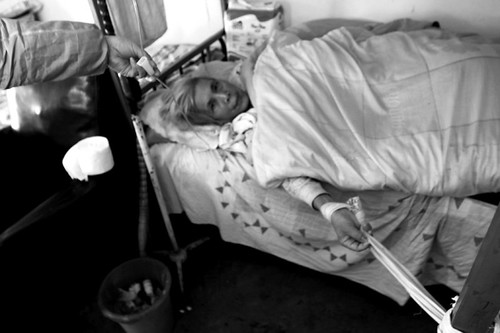 ds more time staring at his age spots than reading.
Someday, maybe soon, an orderly with bad tattoos will find him lying in his bed without a pulse, and his adult diaper soiled.
And that will be that.
But Poetry isn’t dead yet. She is simply ignored, forgotten by the many like some ancient god, no longer worshipped, no longer treasured. You can find her in the bargain bin or in some dusty corner of a chain book store.
Oh, there’s a few who deign to visit her now and then. Guiltily bringing her flowers and then sitting awkwardly across from her trying to pretend her breath doesn’t stink and convincing ourselves that we still love her. In fact, sometimes we can see the beauty still lingering in her eyes.
But we visit less and less.
(Hmmm, the last book of poetry we read was “Nine Horses” by Billy Collins and that was more than a year ago – at least. Maybe we can throw in a few Bukowski poems here and there as well. We keep fingering a new edition of Walt Whitman’s “Leaves of Grass” at the bookstore, but so far we haven’t bought it.)
Wouldn’t it be fun to imagine Video Games in the same state as Poetry? But Video Games is a strapping, young lad with thick arms and a barrel chest. He wears his baseball cap backwards and shuffles around in flip-flops. So what if he’s got the beginnings of a gut and his hair’s a bit wispy on the crown? He’s got powerful thumbs and a cocky attitude (only wish he’d bathe mo re often).
Even TV is doing better than expected. Oh, she’s a had a couple of face lifts (and augmented her breasts), but she’s still a looker (especially in candle light). She still dresses elegantly and her smile is white and dazzling. And can anyone hold her attention better than TV?
But neither Video Games nor TV, of course, visit Poetry. Do they even know her? But then again look around at your friends and family. How often do they talk about Poetry? Is Poetry part of their lives? Most people would rather talk about DVD. Even Poetry’s close friends like Literary Magazine just give her lip service these days (hey, let’s publish another free verse poem about sex!).
Maybe Poetry’s stronger than we think. Maybe the old girl will make a comeback – find the Fountain of Youth. It seems to have worked out all right for Comic Book. Look at how fancy he’s gotten since changing his name to Graphic Novel.
Famous Literary Characters in the Free MarketLurid Confessions of a Man Book Whore
Christine Larson's poem "Five"
Labels: Essay, Poetry, reading
StumbleUpon |
Digg |
del.icio.us |
Reddit |
Technorati |
E-mail
A Literary Quest to Visit the World-Famous
I am a lost soul.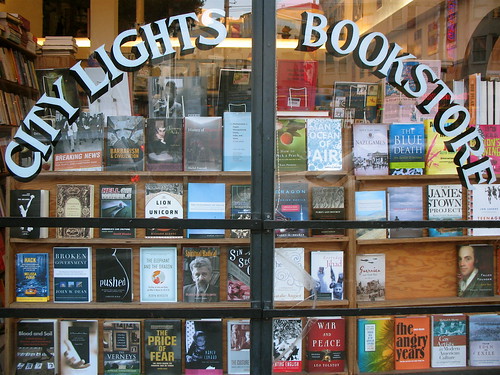
But I know that I’m not alone. We’re all lost in one way or another. Some of us are lost in the hedonism of youth – blind to everything except the next party, the next pick-up, and the next fun-filled weekend. Others are lost in family obligations – mortgages, diapers, tuition, taxes, and car payments. Yet others are lost in the meaningless pursuit of career and money – selling software or hardware, flying to conventions, attending meetings, and focused on providing solutions to make business faster, easier, and more productive.
Lost in the complications of modernity. But I am really lost – in
Unlike all the other lost souls – I know the way out. I am on a quest. I am in search for a place that holds all the answers. A mystical place with all the collected wisdom of the ages. A place where the dead speak.
I am looking for a book store. A book store called City Lights.
There’s only one thing for me to do now.
Eat.
The restaurant is called
There is a white couple at the table next to me. As I study the menu, I overhear the man (who has an oval head and short, prickled hair like the bristles of a toothbrush) say to the woman (his daughter?):
“The Catholics cut a deal with Hitler and they’ve been rationalizing it away ever since.”
The rather careless waitress spills my green tea and doesn’t seem very concerned about it. I mop it up with my napkin after she departs. Overhead a sugary Chinese pop song plays on the hidden speakers. It is the kind of music that would cause inmates to riot and depressed teenagers to drown themselves in their family bathtubs.
But my instincts about the food were dead on. It’s hot and delicious. The shrimp dumplings are tasty and the barbequed pork melts on my tongue.
I follow the directions given to me by the host. Evening has settled in and the chill has become a frigid cold. I walk, hands buried deep in my pockets, pass the shops selling t-shirts, Bud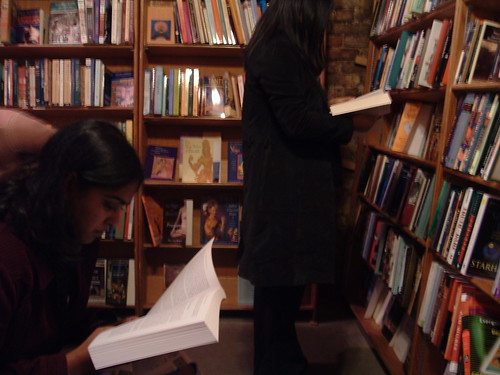 dha figurines, and other trinkets.
Soon I’m at
City Lights Bookstore was founded in 1953 by the beat poet Lawrence Ferlinghetti (and Peter D. Martin). The store (named after the Charlie Chaplain movie) became a hang-out for the Beats. City Lights became world-famous after it was sued for obscenity for publishing Allen Ginsberg’s “Howl,” now considered a classic beat poem. The independent book store is now a
This being
The interior is crowded with wooden book shelves – overflowing with tomes. The first floor is filled with novels, best-sellers, and magazines. I follow the squeaky wooden steps down to the basement. It is a wonderful place with signs describing the categories of books: “Stolen Continents,” “Muckraking,” “Anarchism,” “Class War,” and “People’s History.”
Ah.
I buy lots of books. I am lost no more.
5 Questions About: Jane Austen
Knock Your Socks Off Great Books
Read our literary criticism of Ring Lardner's "The Haircut"
Labels: books, City Lights Bookstore, Essay
StumbleUpon |
Digg |
del.icio.us |
Reddit |
Technorati |
E-mail

In the sci-fi classic “The Matrix,” a software program that tracks and eliminates rogue humans called Agent Smith shares his low opinion of the human race, which, he admits, disgust him:
“I'd like to share a revelation that I've had during my time here. It came to me when I tried to classify your species and I realized that you're not actually mammals. Every mammal on this planet instinctively develops a natural equilibrium with the surrounding environment but you humans do not. You move to an area and you multiply and multiply until every natural resource is consumed and the only way you can survive is to spread to another area. There is another organism on this planet that follows the same pattern. Do you know what it is? A virus. Human beings are a disease, a cancer of this planet.”
It’s a disturbing image – and one that might be difficult to refute these days. Conventional wisdom suggests that we’ve entered a tipping point on the environment. Our culture of modern conveniences, technologies, and machines has knocked the natural order of the planet, well, into orbit.
Our sins are many from increases in industrial farming (requiring chemical fertilizers, ever-increasingly potent pesticides, and overuse of antibiotics on cattle and chickens) to an overabundance of smog-clogging automobiles causing air pollution and ozone depletion.
But a careful review of the mounting evidence seems to show that we aren’t heading for a major crisis – but that we’re already knee-deep in one. Just take a glimpse at the recent news headlines:
- Honeybees are dying by the millions – up to 90 percent of hives in some regions. Biologists call the unknown killer “colony collapse disorder” – a colorless government term for labeling this fierce and mysterious plague. Honeybees are crucial to pollinating flowers and fruits (apples and oranges, for example, can’t grow without them). In fact, the U.S. Department of Agriculture says honeybees pollinate about $15 billion worth of crops in the
- Thousands of bats in the Northeast are dying from a mysterious disease and biologists are worried that tens of thousands of bats could die this year. Many bat caves have seen 100 percent mortality rates. Scientists are speculating that that toxins and pesticides have weakened the bats and destroyed a lot of their food supplies in the last few years – making them susceptible to disease. There has also been speculation that the electromagnetic radiation emitted by cell phones is responsible. Bats are crucial to controlling insect populations – especially mosquitoes.
- Climate change, caused by carbon dioxide emissions, continue unabated. The number of category 4 and 5 hurricanes has doubled in the last 30 years, Malaria has spread to higher altitudes, ice flow from glaciers in Greenland has more than doubled in the last 10 years, and 279 species of plants and animals are moving closer to the poles, according Al Gore’s movie “An Inconvenient Truth.”
- The dead zone in the Gulf of Mexico at the mouth of the Mississippi River has become as large as the state of
If these four examples don’t convince you that human activity is changing the environment then perhaps reports from the World Health Organization that global cancer rates may increase by as much as 50 percent by 2020 will.
Yet, the conversation on how to turn back – to save what we haven’t yet destroyed – continues to be a backburner issue, especially in the United States.
Perhaps one reason is our arrogance and unfounded confidence that the technologies that brought us to this precipice will ultimately save us. This is ironic since these technologies (automobiles, air conditioning, plastics, radiation, etc.) are what have led us here in the first place.
We have a tendency to embrace new technologies before we fully understand how they will affect us in the long term. Isn’t that why we painted our homes with lead paint and used asbestos to insulate our pipes? Recently, we’re learning that plastic water bottles – already owned by most American families – may increase the risk of cancer.
As Agent Smith might have observed, human beings think they can improve Mother Nature. We believe that we can do it better – despite a history of shoddy results.
That’s why we end in situations like this one: We force feed our cattle corn – when they evolved to eat grass. By forcing them to eat corn, the majority become sick, so we treat the corn with antibiotics to keep the cattle alive and healthy long enough to slaughter them. As a result, we dine on sick, drug-infused beef while overusing antibiotics to a point that they’re becoming less effective.
Or why we end up pouring tons of chemicals on our lawns – forcing grass to grow lush and green in environments unnatural to the species. Believe it or not, but Arizona isn’t supposed to have grass. It’s a desert.
It’s time for the environment to become a top and urgent priority in the
Read some of our other essays:
How Leaf Blowers Are Causing Too Much Air PollutionThe Trouble with the Mormon Religion
Labels: environment, Essay, Global Warming, water
StumbleUpon |
Digg |
del.icio.us |
Reddit |
Technorati |
E-mail
 My neighbor rarely ventures outside of her house. There really is no reason to. Her groceries – peanut butter, toilet paper, Oreos, et al – are delivered each week. Her dry cleaner provides door-to-door service. Landscapers roll up in pick-up trucks like clockwork every time her lawn needs to be mowed or raked. DVDs come in the mail – along with her books.
Pizza and Chinese food deliveries occur a few times a week. And, of course, she has Internet access and cable TV.
Her house is beginning to look a lot like a cocoon.
It’s time to admit that as Americans we’re addicted to shortcuts. We want things to be fast, easy, and cheap. And that spells: convenience. Americans aren’t lazy. Our work productivity is the highest in the world. We work longer hours and take less vacation than other developed nations. But we’re obsessed with saving time (what we’re saving it for is unclear).
Take these rather alarming statistics pointing to our addiction to convenience:
- The staggering increase in the popularity of disposal cameras – even disposable digital cameras. Analyst firm IDC said disposal camera sales reached a high of 460 million units in 2004.
- About 30 percent of all households across the United States (about 34 million homes) use landscaping companies to maintain their lawns and yards. Consumers in the U.S. spent more than $44.7 billion on landscaping, according to the National Gardening Association. The growth of landscaping services increases about 10 percent each year.
- The market for grocery delivery is expected to reach a high of $7.5 billion in 2008. The average time it takes to order groceries is about 10 minutes, according to a report in the Canadian Press. Why go to the supermarket?
- 2007 marked the sixth consecutive year that online sales increased at a double-digit rate. Last year, online sales hit an all-time high of about $62.7 billion.
- Going out to eat – even at fast food and casual restaurants is declining in favor of “prepared foods” consumers can buy at supermarkets (or have delivered by supermarkets) and pop into the microwave oven at home, according to a study by Technomic.

Americans view these everyday tasks as chores – unnecessary inconveniences and time wasters better delegated to another. But it’s a mistake to think of these things as chores – they’re responsibilities. They’re the cost of self-sufficiency (and, quite frankly, help build character). Isn’t the child who does their own homework better off than the child who pays someone else to do it?
There is, of course, an enormous price for all of this convenience: pollution, climate change, and energy consumption. But the high social and cultural costs may be the most damaging. All this convenience – and buck passing – is isolating individuals and eroding the social fabric of our neighborhoods and communities.
This disconnect may be this is why Americans continue to believe our society is at its most dangerous point in history despite a long-time trend in declining violent crime rates (the homicide rate in 2005, for example, was at its lowest point since 1965. But good lucking trying to convince people of that).
My parents knew all of their neighbors intimately. The women all stayed home with their children – set up play dates, babysat for each other, visited each other for lunch and tea. My father knew the men because every weekend they were outside cutting their lawns, trimming their hedges, painting their houses and garages, washing their cars, and performing other regular maintenance on their homes. They took breaks together, borrowed tools from each other, and shared beers at the end of the day.
That forged friendships which lead to family barbeques, joint vacations, dinner and movie dates, dinner parties, etc. When I was growing up, I was intimate with the insides of every neighbor’s house, played with their children, knew their relatives, and thought of neighbors as surrogate parents.
Now as an adult, I’ve never been inside any of my neighbors’ houses, except for one. Only four people out of 10 houses on my section of street even cut their own lawns (and this includes a 75-year-old widow).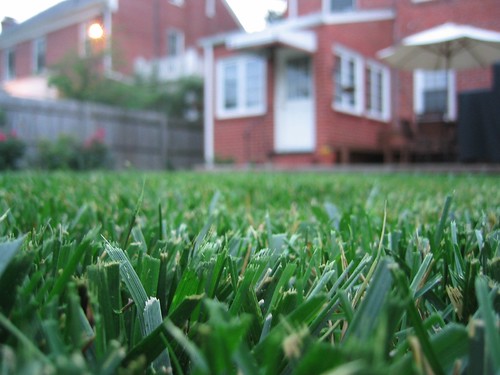
Our thirst for convenience undermines our communities. Ordering DVDs over the Internet has closed down one of the two video stores in town. Amazon.com and other online book retailers shuttered the two bookstores many years ago. Home theater will eventually eradicate movie houses. Can gourmet “prepared meals” soon replace restaurants?
We even let convenience erode services we used to get for free. That’s why we now pump our own gas and why we’re starting to check-out and bag our own groceries at the supermarket. Because doing it alone is faster.
Convenience has become an addiction. One all responsible adults should try and break. Mow your own lawn. Rake rather than use a gas-powered blower. Paint your house. Go food shopping. These tasks? These chores?
It’s called life.
The long and painful suicide of newspapers
Why all U.S. employees -- from lawyers to construction workers -- need a bill of rights
Labels: Convenience, Culture, Essay, Society
StumbleUpon |
Digg |
del.icio.us |
Reddit |
Technorati |
E-mail
Spring has arrived in New England.
There were two obvious signs. First was the purple crocus poking its shiny head through the wet soil of my backyard garden.
The second was the screaming roar of the gas powered leaf blowers being used by the landscapers in my neighbor’s yard. The noise was deafening – bone rattling – and shattered the morning quiet.
It was as if the leaf blowers snuck up on silence and beat it to death with thick oak clubs.
I closed my eyes and drank my coffee – quietly mourning tranquility.
The racket ended after 35 grueling minutes. I savored the silence until, of course, another landscaping crew arrived at another neighbor’s house and the shriek of the leaf blowers once again murdered tranquility.
Poor tranquility.
And say nothing of my shot nerves and the growing annoyance eating away inside my belly like a cancer.
Gas powered leaf blowers – the kind commonly favored by landscaping companies – produce sound decibels between 80-90 dBA. The U.S. Occupational Safety and Health Administration (OSHA) consider noises above 85 dBA to be dangerous.
But noise is only part of the problem.
Consider this:
- A single gas-powered leaf blower- and more than 2.5 million of them will be sold this year alone- can emit as much pollution in a year as 80 cars, according to an article in U.S. News & World Report.
- Leaf blowers can push air up to 200 mph and fill the air with dust, fecal matter, pesticides, chemicals, fungi, spores, and fertilizer at about five pounds per hour per blower, according to a report by an Orange County grand jury. The dust takes about one hour to settle.
- More than 200 cities and towns in the United States have banned gas powered leaf blowers as a nuisance and public health hazard, according to an editorial in the Nashua (N.H.) Telegraph.
- U.S. retailers sold almost three million leaf blowers in 2006, according to an article in the Boston Globe.
It’s amazing how people put convenience ahead of comfort. Any reasonable thinking person must understand that leaf blowers are dirty, noisy, expensive, and impractical. There are also several studies that show that raking is actually more efficient and faster than using a leaf blower. It also gives people exercise.
Yet per usual – technology – or rather the promise of technology – wins out. Baby boomers and Gen Xers love short cuts, especially when the short cut includes an electronic device. Why do you think we have 40-year-old fathers prowling playgrounds wearing their mobile devices in holsters like they were six shooters?
Gas powered leaf blowers are a bad idea. They should be banned and if a ban isn’t feasible, there should be strict restrictions on the hours in the day when they can be operated. As a society, we don’t put much emphasis on decreasing noise pollution. But noise pollution can have serious health effects.
According to Wikipedia, noise health effects are the heath consequences of elevated sound levels. Over exposure to elevated noise levels can cause hearing loss, hypertension, heart disease, annoyance, and sleep disturbance. Elevated noise levels can also create stress, increase accidents at work and at home, stimulate aggression and other anti-social behavior.
Put away the leaf blower and buy a rake.
Labels: Essay, Leaf Blowers, Noise Pollution, Work Ethic
StumbleUpon |
Digg |
del.icio.us |
Reddit |
Technorati |
E-mail
Foppish Tales of Overindulgence and
Literary Snobbery
 ng
I smell the pages of new books. The intoxicating perfume of fresh pulp makes me light headed. I’m a literary panty-sniffer. I skulk between the stacks at bookstores, crack open the pages of new book, and stick my snout right into the spine to snort like a sow in heat.
Snark! Snark! Ahhhh…
It’s unbecoming, I know. So I hide this behavior – who wouldn’t? I find lonely nooks in the bookstore and carefully scout the vicinity to make sure I’m not being watched (damn those security cameras!). Then when I’m sure I’m alone, my nose takes the plunge.
Snark! Snark! Ahhhh…
Do the pantie-sniffing perverts operate this way in
Oh, the humanity!
 On Ignoring Updike
I’ve scorned John Updike. I’ve never finished one of his novels – nor have I read any of his articles, short stories, or grocery lists. I started reading “The Witches of Eastwick” and “Rabbit, Run.” Both books bored me to tears within the first few pages.
I confess to being mystified and slightly irritated by Updike and his success. He’s one of poster children for the intellectual
I’m no expert on Updike’s writing (how could I be?). But from what I’ve read, Updike’s writing seems too crafted – too unnatural. It reads like it was written and then rewritten and then edited.
That said I will always give the little literary bitch credit for calling
That’s just perfect.
Stolen Moments of Delight
I get around. I read about 50 books a year – but I buy about three times that number. My unread stack is enormous: A skyscraper built with low quality concrete. If it topples, it will crush my neighbor’s house.
I could stop buying new books right now and have enough reading material for the next five years (especially if I break into the books that have been packed into boxes and now reside in the bleakness of my basemen t – poor darlings).
My addiction drives my wife crazy. When I come home with a new book – I get the look. If only she knew the truth – that I hide most of my purchases. When I go to a bookstore (snorting away in my private moments) and make a flurry of purchases, the items rarely make it out of my car trunk.
I’ll wait for the coast to be clear before smuggling them inside.
I’m a sad, sad man.
Soft, Not Hard
I prefer not to read hardcover books – and I rarely buy them. But I’m not a fan of paperbacks either. I prefer the oversized, trade paperbacks.
I love them.
They smell divine and they’re easy to handle while reading in bed.
Rrrrrr.
Playing Favorites
I don’t play favorites either. One question that stumps me always is: Who is your favorite author. Why not ask me if I love my mother or father best? Or which one of my children is better?
Book Man-Whores love many authors. Dearly! Passionately!
But I do have a stable of writers I return to often: Tobias Wolff, Pete Dexter, Tim O’Brien, Michael Connolly, Ernest Hemingway, William Faulkner, and Charles Dickens.

I Own You
I don’t like to share my books. Why should I? But even worse, I need to own them – dominate them completely. That’s why libraries are useless to me. Borrowing books feels sleazy and dishonest (have you seen those hideously unfriendly librarians in action?).
And have you smelled a library book?
Yuck!
But part of me wishes I could sink the level of “borrowing.” Think of the money I’d save (and the storage space I’d get back). Ownership – possession – is part of the addiction to me.
Why we recommend avoiding "Darkly Dreaming Dexter"
How books are really time machines
Labels: books, Essay, John Updike, literature
StumbleUpon |
Digg |
del.icio.us |
Reddit |
Technorati |
E-mail

 RSS Feed
]saddlebrown]tan]maroon](],](])us.st11.yimg.com/us.st.yimg.com/I/getfishy_1912_2002960]Fishboy]black],]1]10]3]1]1]1]1]1]1]1]1]1],](](]papayawhip])])]DaRK^20PaRTY^20ReVIEW]^3A^3ALiterate^20Blather^3A^3A],](](],](]maroon](](](]brown](],](]maroon](](](],]60]10],](](]^23F5ECE1])])]maroon]0.5]0],](](]^23F5ECE1])])]maroon]^23F5ECE1])])]^23666]16]maroon]maroon],](](]maroon](],](]^23333]^238C4614]tan],](](]^23F5ECE1])])],](](]^23F5ECE1])])],](](]^23F5ECE1])])],](]maroon]maroon]15]3]23]18]maroon],](](],](],](](],](]black](](](],](](](],]black](](](],](](]^23333](](](](](],]^2336F]^23333](],](]Posted^20by^20^24AUTH^20at^20^24TIME.]36],](](]black])])]^23F5ECE1])])]^23666]16]maroon]maroon],](](]maroon](],](]^23333]^238C4614]tan]Contributors]]]^24PROFILE]]]DaRK^20PaRTY^20LiNKS]]]The^20Ambrose^20Bierce^20Site])donswaim.com/]Ambrose^20Bierce]Ironic^20Times])www.ironictimes.com/index.html]Ironic^20Times]Gallery^20Voyer])www.voy-art.com/]Gallery^20Voyer]Tintinologist])www.tintinologist.org/]Tintin]Arcanum^20Cafe])www.arcanumcafe.com/]Arcanum^20Cafe]LADA^20-^20Protect^20our^20Kids])da.co.la.ca.us/pok/poklist.htm]POK^20List]Tom^20Caron^20-^20Boston.com])www.boston.com/sports/nesn/aboutus/onair/tomcaron/]TC]The^20Captain^20Humphreys^20Project])www.captainhumphreys.com/]Captain^20Humphreys]Torpedo^20Design])www.torpedodesign.com/]Torpedo^20Design]^3Cimg^20src^3D^22)us.st11.yimg.com/us.st.yimg.com/I/getfishy_1912_2002960^22^20alt^3D^22Fishboy^22^20style^3D^22border^3A^201px^20none^20black^3B^22^20/^3E])www.fishboy.com/]Fishboy]Etc]]]^3Cimg^20src^3D^22)psyc.horm.org/barimg/bar_psycho.png^22^20width^3D^2280^22^20height^3D^2215^22^20alt^3D^22PsycHo^3A^20Free^20Template^20Generator^22^20style^3D^22border^3A^200px^20solid^20black^22^20/^3E]^24PSYCHO]PsycHo^3A^20Free^20Template^20Generator]^3Cimg^20src^3D^22)psyc.horm.org/barimg/bar_firefox.png^22^20width^3D^2280^22^20height^3D^2215^22^20alt^3D^22Get^20FireFox^21^22^20style^3D^22border^3A^200px^20solid^20black^22^20/^3E])www.mozilla.org/products/firefox/]Get^20Firefox^21]^3Cimg^20src^3D^22)psyc.horm.org/barimg/bar_xhtml.png^22^20width^3D^2280^22^20height^3D^2215^22^20alt^3D^22XHTML^20Validator^22^20style^3D^22border^3A^200px^20solid^20black^22^20/^3E])validator.w3.org/check/referer]XHTML^20Validator]Recent^20Posts]]]^24RECENT]^20]]Archive]]]^24ARCHIVE]^20]]ADVERTISEMENTS]]]^20]]^26^2361470^3BPsycHo})


This work is licensed under a Creative Commons Attribution-No Derivative Works 3.0 License.
The Template is generated via PsycHo and is Licensed.