
Poem: Sunrise Over Worcester
5 Questions About: Jason Pinter
12 Signs That You Might Be A Banker
The 9 Worst Movies to Win Oscars
Book Review: Narrow Miss for "Above the Law"
5 Questions About: Screaming Blue Messiahs
What's Up With All the Fat, Naked Guys?
Thoughts from the Shadows: The Craziness of Publis...
How to Make a Damn Good Horror Movie
Literary Criticism
Fantastically Bad Cinema
Essays
Under God's Right Arm
June 2006
July 2006
August 2006
September 2006
October 2006
November 2006
December 2006
January 2007
February 2007
March 2007
April 2007
May 2007
June 2007
July 2007
August 2007
September 2007
October 2007
November 2007
December 2007
January 2008
February 2008
March 2008
April 2008
May 2008
June 2008
July 2008
August 2008
September 2008
October 2008
November 2008
December 2008
January 2009
February 2009
March 2009
Alcoholic Poet
Baby Got Books
Beaman's World
BiblioAddict
Biblio Brat
Bill Crider's Pop Cultural Magazine
The Bleeding Tree
Blog Cabins: Movie Reviews
A Book Blogger's Diary
BookClover
Bookgasm
Bookgirl's Nightstand
Books I Done Read
Book Stack
The Book Trib
Cold Hard Football Facts
Creator of Circumstance
D-Movie Critic
The Dark Phantom Review
The Dark Sublime
Darque Reviews
Dave's Movie Reviews
Dane of War
David H. Schleicher
Devourer of Books
A Dribble of Ink
The Drunken Severed Head
Editorial Ass
Emerging Emma
Enter the Octopus
Fatally Yours
Flickhead
The Genre Files
The Gravel Pit
Gravetapping
Hello! Yoshi
HighTalk
Highway 62
The Horrors Of It All
In No Particular Order
It's A Blog Eat Blog World
Killer Kittens From Beyond the Grave
The Lair of the Evil DM
Loose Leafs From a Commonplace
Lost in the Frame
Little Black Duck
Madam Miaow Says
McSweeney's
Metaxucafe
Mike Snider on Poetry
The Millions
Moon in the Gutter
New Movie Cynics Reviews
Naked Without Books
A Newbie's Guide to Publishing
New & Improved Ed Gorman
9 to 5 Poet
No Smoking in the Skull Cave
Orpheus Sings the Guitar Electric
Polly Frost's Blog
Pop Sensation
Raincoaster
R.A. Salvatore
Reading is My Superpower
Richard Gibson
SciFi Chick
She Is Too Fond Of Books
The Short Review
Small Crimes
So Many Books
The Soulless Machine Review
Sunset Gun
That Shakesperherian Rag
Thorne's World
The Toasted Scrimitar
This Distracted Globe
Tomb It May Concern
2 Blowhards
Under God's Right Arm
A Variety of Words
The Vault of Horrr
Ward 6
When the Dead Walk the Earth
The World in the Satin Bag
Zoe's Fantasy
Zombo's Closet of Horror
Bookaholic Blogring
Power By Ringsurf

(Perhaps it was destiny that Duane Swierczynski became a writer – his name contains just about every letter in the English alphabet. Duane is the author of several sizzling fast thrillers – including the high-octane “Severance Package” (which was recently optioned by Lionsgate for a

DaRK PaRTY: What's the deal all of a sudden with comic book writers turned novelists? Are you all serious writers struggling to get discovered?
Duane: If I wanted to get discovered, I'd come up with a cure for static cling (I'm close, damnit... so, so close...). But I was a novelist first, and the comic book writing thing was a happy surprise. To
me, it's a way to satisfy my storytelling urges in two very different ways. Novel writing is a long, solitary enterprise; comic scriptwriting is collaborative and deadline-oriented. I like having both.
DP: You're also a former journalist. Is writing for a newspaper a good training ground for writing fiction?
Duane: I think so -- look at James M. Cain, Laura Lippman, Michael Connelly, and the other dozens of crime writers who started out as newspaper reporters or columnists. If you're lucky, you'll encounter some editors who will help you beat a lot of the bad writing out of your system. There's nothing like seeing a page of your writing covered in red ink.
DP: You recently decided to stop working a full-time salaried job to dedicate yourself to your own writing. Was it a difficult decision? Isn't it kind of like tightrope walking without a net?
Duane: Actually, I have a net -- an exclusive contract with Marvel Comics. That said quitting my job wasn't exactly an easy decision. But I'm glad I did it.
DP: Your latest novel "Severance Package" is a full throttle thriller with lots of gore. A lot of reviewers have compared it to a movie. Did you visualize it as a film or a comic book first? What was the writing pr ocess like for this book?
Duane: It was always meant to be a novel. And it followed my usual pattern: I started out with a situation, then kicked around some characters who would be ideal for that situation, then came up with a vague goal in mind -- where I thought I wanted the characters to end up. But most of the writing was improvised; I plotted very little in advance; which is essential for me. Nothing worse than being bored by your own story.
DP: Who are your favorite fiction writers and which writers of the past have inspired you?
Duane: There are too many living novelists to include, and I wouldn't want to leave someone important out. But as far as dead ones -- aside from the usual suspects? Fredric Brown was a huge influence, because he knew how to inject humor into a story like nobody else. And James M. Cain for his economy and muscle. I read a lot of their work early on, and I keep coming back to them.
5 Questions for the Author of "The Stupidest Generation"
An Interview with Best-Selling Author Kim Harrison5 Writers Every Man Should Read
Labels: 5 Questions, Duane Swierczynski, interview, thrillers, Writing
 StumbleUpon |
 Digg |
 del.icio.us |
 Reddit |
 Technorati |
 E-mail

An Interview with Novelist Michael Marshall Smith
(Writer Michael Marshall Smith (who also writes under Michael Marshall) is a thriller writer in the UK who knows how to do several things really well: frighten people, make them glance nervously over their shoulders, and write with a tense, driving confidence that makes you hang on to his books as if you were clinging to a cliff side. We recently caught up with him to talk about writing thrillers, his career as a man of dark letters and his intersecting relationship with Stephen King.)

DaRK PaRTY: What attracts you as a writer to the horror and thriller genre?
Michael: To be honest, I don't understand why anyone would write anything else. These are the genres where you can try to write tense, involving fiction, treading the fine line between reality and otherworldliness, and exploring the darkest and most vital aspects of human nature to your heart's content - while at the same time dealing with everyday existence just as fully and deeply as any other genre.
So why not? I've tried writing other types of fiction, but within a few pages my fingers always end up steering toward the shadows. I've given up fighting that impulse, to be honest.
DP: “The Straw Men” (2002) was remarkable for its tense paranoia -- especially since it was released right after 9/11 -- and ability to keep readers tearing through the pages. What's the origin of the storyline and your thoughts on the book?
Michael: Like a lot of books, I suspect, the original idea came not to occupy a huge part of the final narrative. The question I initially found myself considering was why, given the disadvantages at the time, humankind stopped its hunter-gatherer existence and began farming.
Kind of an abstract point, I'll admit, but no-one's really nailed the question, and so I came up with a (rather unlikely) explanation - which I then realized could be used to rationalize very unpleasant ways of living. And from this came the idea of “The Straw Men.” As the series progressed, the conspiracy became more complex and its roots began to draw from further back in history. And these parts came to me with surprising ease, as if I was remembering something I already knew. I've almost forgotten that some of it (probably) isn't true, in
fact.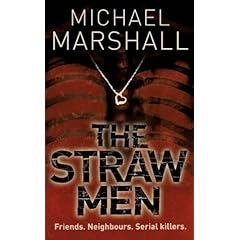
DP: You are adapting Stephen King's short story "Mrs. Todd's Shortcut" about a woman obsessed with finding shorter routes through the back roads of
Michael: I remember reading it years and years ago, and it striking a very vivid chord - even when placed amongst all the other great short stories in that collection. I know when I was writing the first draft of the adaptation, just before Christmas, that the thing that really spoke to me (as it often does with King's work, especially that written in the last five to 10 years) is the melancholy, the quiet and very real horror of chances missed and the irrevocability of time's passing.
Of course that traditional King element of other realms existing just to the side of ours has great appeal too (and is something I often touched on in my Michael Marshall Smith novels), but it's his grip on the human that's always really appealed to me about his work. For such a short story, it packs an amazing punch.
DP: King has written blurbs for your books -- and called "The Straw Men" brilliantly written and scary as hell. Have you met King? What's your relationship with him?
Michael: I don't really have one. I did meet him once - very briefly - at the
A mutual friend brought King over and introduced us. Sadly I was rendered utterly inarticulate, muttered something inaudible, and King moved on.
To receive his blurb for “The Straw Men” a number of years later was
definitely one of the highlights of my career. King was probably the thing that inspired me most to start writing, and to receive any kind of validation from him -- Well, you can probably imagine.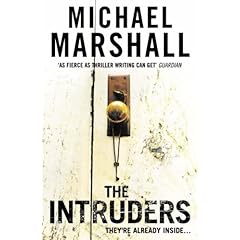
DP: You've just published "The Intruders" in 2007 (with the paperback due this year). Can you tell us about your latest thriller?
Michael: Well, it's a step to the side from the last three novels – “The Straw Men” books -- in that I've allowed myself to re-introduce a few slightly otherworldly elements. I don't think they're incredible, but they're not based completely in consensual reality, so I guess perhaps it represents a move back toward the horror field that I started out in.
If you liked this interview then try:
Read our "5 Questions" feature with Fantasy Writer R.A. Salvatore here
Read about our own warped relationship with Stephen King here
Read our picks for the 5 Scariest Stephen King novels here
Labels: 5 Questions, interview, literature, Michael Marshall Smith, Stephen King, thrillers
StumbleUpon |
Digg |
del.icio.us |
Reddit |
Technorati |
E-mail

Now then. This is the Lou Archer School of Hard Knocks for Private Eyes. I’m Head Master Continental Op. To my left is Professor Travis McGee and to my right is Professor Mike Hammer.
We’d like to welcome our ex-police officers, ex-city reporters and ex-military officers to the first day of school. We ask that you leave your liquor bottles, bad attitudes, failed marriages, propensity to use violence to solve difficult problems, and wise-cracks outside of the classroom.
Yes, Spenser, this means you. And please, can you ask Ms. Susan Silverman to step outside? This orientation is for students only. Thank you.
We have a full day ahead of us so let me outline the classes.
First period we’ll get right to the physical aspects of the job with “How to Take a Punch.” Then we’ll move on to “Serial Killers, Hitmen & Mobsters” followed by “Heart of Gold Economics: How to Earn a Living without Charging Clients.” Then it is off to the aforementioned “Beat Down” class.
Then we’ll break for lunch: steaks (cook rare, of course), fries, cold beers and black coffee. After the smoking break we’ll continue with classes.
Fifth period will be “Insults: Delivery is the Key.” Sixth period will be “Handguns: Blow Away Bad Guys Not Bystanders.” Then we’ll end the first day with “Dark Musings: How your Hometown Shapes Your Attitude.” And yes, Mr. Stoner,
Here is the syllabus for the first semester – five modern private eye novels we think rise to the top of genre:
Crais has developed a reputation for hit or miss mystery novels – especially with his main protagonist 
Burning Echo by Lee Child (2002)
Former MP Jack Reacher is one of the toughest characters in private eye fiction. The beauty of the Reacher novels are their ability to straddle genres – some of the books are military thrillers, others action adventure and still others classic private eye mysteries. “Burning Echo” is the latter. It’s one of those novels where the bad guys are really “bad” and the good guy gets to deliver a severe punishment that has the reader fully onboard with Old Testament justice. Such is the power of Lee Child’s prose. “Burning Echo” takes place in the badlands of
The Devil Knows You’re Dead by
Any one of the masterful Matthew Scudder novels could have made this list, but “The Devil Knows You’re Dead” tops the list because of its literary ambitions. Scudder is an ex-cop and ex-alcoholic who works as an unlicensed private eye in  ghborhood. The story here is about Scudder investigating the murder of a prominent lawyer by a homeless
In the Electric Mist with Confederate Dead by James Lee Burke (1994)
This is the sixth novel in the long-running Dave Robicheaux series – and the best. James Lee Burke seems to have run out of gas on the character in recent years, but “In the Electric Mist with Confederate Dead” has the author in top form (and what a title!). The book is about a psychopathic mobster disrupting a movie set by murdering women and features a spooky ghost story as Robicheaux communes with long-dead confederate general, John Bell Hood. No one paints a setting better than Burke – and readers will be able to feel, smell, and hear the
The Straw Men by Michael Marshall (2002)
This is one of the finest debut mysteries – ever. It’s a paranoid mix of “X-Files,” Stephen King and a good, old fashioned private eye novel. There are two seemingly disparate plots that meet in the middle, but the primary character is ex-CIA analyst Ward Hopkins who is investigating the mysterious death of his parents. “The Straw Men” is the rare novel that keeps the reader absolutely going in circles trying to figure out the intricate plot. Do yourself a favor and get this book.
Labels: books, literature, mysteries, novels, Private eyes, thrillers
StumbleUpon |
Digg |
del.icio.us |
Reddit |
Technorati |
E-mail

 RSS Feed
]saddlebrown]tan]maroon](],](])us.st11.yimg.com/us.st.yimg.com/I/getfishy_1912_2002960]Fishboy]black],]1]10]3]1]1]1]1]1]1]1]1]1],](](]papayawhip])])]DaRK^20PaRTY^20ReVIEW]^3A^3ALiterate^20Blather^3A^3A],](](],](]maroon](](](]brown](],](]maroon](](](],]60]10],](](]^23F5ECE1])])]maroon]0.5]0],](](]^23F5ECE1])])]maroon]^23F5ECE1])])]^23666]16]maroon]maroon],](](]maroon](],](]^23333]^238C4614]tan],](](]^23F5ECE1])])],](](]^23F5ECE1])])],](](]^23F5ECE1])])],](]maroon]maroon]15]3]23]18]maroon],](](],](],](](],](]black](](](],](](](],]black](](](],](](]^23333](](](](](],]^2336F]^23333](],](]Posted^20by^20^24AUTH^20at^20^24TIME.]36],](](]black])])]^23F5ECE1])])]^23666]16]maroon]maroon],](](]maroon](],](]^23333]^238C4614]tan]Contributors]]]^24PROFILE]]]DaRK^20PaRTY^20LiNKS]]]The^20Ambrose^20Bierce^20Site])donswaim.com/]Ambrose^20Bierce]Ironic^20Times])www.ironictimes.com/index.html]Ironic^20Times]Gallery^20Voyer])www.voy-art.com/]Gallery^20Voyer]Tintinologist])www.tintinologist.org/]Tintin]Arcanum^20Cafe])www.arcanumcafe.com/]Arcanum^20Cafe]LADA^20-^20Protect^20our^20Kids])da.co.la.ca.us/pok/poklist.htm]POK^20List]Tom^20Caron^20-^20Boston.com])www.boston.com/sports/nesn/aboutus/onair/tomcaron/]TC]The^20Captain^20Humphreys^20Project])www.captainhumphreys.com/]Captain^20Humphreys]Torpedo^20Design])www.torpedodesign.com/]Torpedo^20Design]^3Cimg^20src^3D^22)us.st11.yimg.com/us.st.yimg.com/I/getfishy_1912_2002960^22^20alt^3D^22Fishboy^22^20style^3D^22border^3A^201px^20none^20black^3B^22^20/^3E])www.fishboy.com/]Fishboy]Etc]]]^3Cimg^20src^3D^22)psyc.horm.org/barimg/bar_psycho.png^22^20width^3D^2280^22^20height^3D^2215^22^20alt^3D^22PsycHo^3A^20Free^20Template^20Generator^22^20style^3D^22border^3A^200px^20solid^20black^22^20/^3E]^24PSYCHO]PsycHo^3A^20Free^20Template^20Generator]^3Cimg^20src^3D^22)psyc.horm.org/barimg/bar_firefox.png^22^20width^3D^2280^22^20height^3D^2215^22^20alt^3D^22Get^20FireFox^21^22^20style^3D^22border^3A^200px^20solid^20black^22^20/^3E])www.mozilla.org/products/firefox/]Get^20Firefox^21]^3Cimg^20src^3D^22)psyc.horm.org/barimg/bar_xhtml.png^22^20width^3D^2280^22^20height^3D^2215^22^20alt^3D^22XHTML^20Validator^22^20style^3D^22border^3A^200px^20solid^20black^22^20/^3E])validator.w3.org/check/referer]XHTML^20Validator]Recent^20Posts]]]^24RECENT]^20]]Archive]]]^24ARCHIVE]^20]]ADVERTISEMENTS]]]^20]]^26^2361470^3BPsycHo})


This work is licensed under a Creative Commons Attribution-No Derivative Works 3.0 License.
The Template is generated via PsycHo and is Licensed.