
Poem: Sunrise Over Worcester
5 Questions About: Jason Pinter
12 Signs That You Might Be A Banker
The 9 Worst Movies to Win Oscars
Book Review: Narrow Miss for "Above the Law"
5 Questions About: Screaming Blue Messiahs
What's Up With All the Fat, Naked Guys?
Thoughts from the Shadows: The Craziness of Publis...
How to Make a Damn Good Horror Movie
Literary Criticism
Fantastically Bad Cinema
Essays
Under God's Right Arm
June 2006
July 2006
August 2006
September 2006
October 2006
November 2006
December 2006
January 2007
February 2007
March 2007
April 2007
May 2007
June 2007
July 2007
August 2007
September 2007
October 2007
November 2007
December 2007
January 2008
February 2008
March 2008
April 2008
May 2008
June 2008
July 2008
August 2008
September 2008
October 2008
November 2008
December 2008
January 2009
February 2009
March 2009
Alcoholic Poet
Baby Got Books
Beaman's World
BiblioAddict
Biblio Brat
Bill Crider's Pop Cultural Magazine
The Bleeding Tree
Blog Cabins: Movie Reviews
A Book Blogger's Diary
BookClover
Bookgasm
Bookgirl's Nightstand
Books I Done Read
Book Stack
The Book Trib
Cold Hard Football Facts
Creator of Circumstance
D-Movie Critic
The Dark Phantom Review
The Dark Sublime
Darque Reviews
Dave's Movie Reviews
Dane of War
David H. Schleicher
Devourer of Books
A Dribble of Ink
The Drunken Severed Head
Editorial Ass
Emerging Emma
Enter the Octopus
Fatally Yours
Flickhead
The Genre Files
The Gravel Pit
Gravetapping
Hello! Yoshi
HighTalk
Highway 62
The Horrors Of It All
In No Particular Order
It's A Blog Eat Blog World
Killer Kittens From Beyond the Grave
The Lair of the Evil DM
Loose Leafs From a Commonplace
Lost in the Frame
Little Black Duck
Madam Miaow Says
McSweeney's
Metaxucafe
Mike Snider on Poetry
The Millions
Moon in the Gutter
New Movie Cynics Reviews
Naked Without Books
A Newbie's Guide to Publishing
New & Improved Ed Gorman
9 to 5 Poet
No Smoking in the Skull Cave
Orpheus Sings the Guitar Electric
Polly Frost's Blog
Pop Sensation
Raincoaster
R.A. Salvatore
Reading is My Superpower
Richard Gibson
SciFi Chick
She Is Too Fond Of Books
The Short Review
Small Crimes
So Many Books
The Soulless Machine Review
Sunset Gun
That Shakesperherian Rag
Thorne's World
The Toasted Scrimitar
This Distracted Globe
Tomb It May Concern
2 Blowhards
Under God's Right Arm
A Variety of Words
The Vault of Horrr
Ward 6
When the Dead Walk the Earth
The World in the Satin Bag
Zoe's Fantasy
Zombo's Closet of Horror
Bookaholic Blogring
Power By Ringsurf
Thomas Perry Welcomes Back Jane Whitefield in New Thriller
 I read “Runner” by Thomas Perry so fast – What happens next! What happens next! – that the pages started to smolder and smoke. I was forced to read the rest of it wearing fire retardant gloves and with a fire extinguisher within easy reach.
“Runner” hits bookstore shelves on January 14 and, once you’ve fireproofed your favorite reading chair, you should seriously consider adding it to your collection. “Runner” is a marvel, and already in the running for my pick for best suspense novel of 2009.
Thomas Perry has always been an underrated scribe. He came out of the gates strong with his first novel “The Butcher’s Boy,” which won the 1983 Edgar Award for best first mystery novel.
But Perry really didn’t hit his stride until he created Jane Whitefield – a Native American woman who helps desperate people “disappear” – guiding them to new lives while helping them escape their pasts, usually filled with various nasty people with guns.
Jane is hard as dried leather – and smart. Her character – the detail oriented, obsessive perfectionist with little humor and a demeanor as sullen as funeral – centers the novel. She’s a fascinating case study as she plunges the reader into the underground world of forgeries and the act of “vanishing” without a trace.
Jane made her first appearance in “Vanishing Act” in 1995 and appeared in four more novels before Perry retired her in 2000. The series, however, has proven so popular, that Perry has dusted off Jane nine years later.
Lucky us. The result is “Runner.”
Jane is now married to a surgeon in up-state New York and living under the name Jane McKinnon. The action begins immediately as a pregnant teenager named Christine tries to find Jane at the local hospital – where Jane is attending a fundraiser she organized.
There are six professional criminals trailing Christine – and they bomb a wing of the hospital in order to flush Christine out of the building. Christine, however, is fortunate enough to find Jane first.
The rest of “Runner” is a harrowing race to save Christine and her baby from her former boyfriend, a corrupt real estate mogul who needs Christine and his child back to avoid being written out of the family businesses by his demanding father and mother.
“Runner” is relentless – but never allows itself to get away from the characters. Perry gives readers complex characters in Christine and boyfriend Richard Beale (and his complicated family dynamics with his mother and father). There are no stereotypes or casting call characters here, but dynamic human beings.
There are some questionable logic lapses in “Runner” with the hospital bombing front and center (would career criminals in a covert operation really do something that dramatic?). And the relationship between Richard and his criminal friends, led by the enigmatic Steve Demming, fails to hold up under too much scrutiny (and we never get any insight into Demming and his colleagues motivations).
However, “Runner” is just too expertly plotted and burns up the pages like a flamethrower to get too caught up in the trivial complaints. The book is just too good for that. Our recommendation is to just guard against third-degree burns and let Jane Whitefield guide you through “Runner.” You won’t be sorry.
Buy "Runner" at Amazon.com
Book Review: "The Brass Verdict" Plays It Safe
Thoughts From the Shadows: Would Jim Thompson Be Published Today?
The Toughest SOBs in Fantasy Fiction
Labels: Blade Runner, book review, Jane Whitefield, mysteries, Thomas Perry
 StumbleUpon |
 Digg |
 del.icio.us |
 Reddit |
 Technorati |
 E-mail

Mediocre Film Making
Back in December, we listed our “8 Coolest Sci-Fi Flicks” and got some heat for not including “Blade Runner” (1982) on the list. We remembered Ridley Scott’s adaptation of Philip K. Dick’s science fiction classic “Do Androids Dream of Electric Sheep” as being a disappointment – as well as a bit heavy-handed.
We recently revisited “Blade Runner” to see if the sands of time had softened our opinion of the movie. But we also wanted to see if Scott’s director’s cut version of the film would improv e it.
e it.
It did, but our opinion of “Blade Runner” remains mediocre.
We agree with film critic Roger Ebert: “Watching the director's cut (of “Blade Runner”), I am left with the same overall opinion of the movie: It looks fabulous, it uses special effects to create a new world of its own, but it is thin in its human story.”
Ebert gets this one right. “Blade Runner” is slick on production. The special effects are so impressive that Scott lets them take over parts of the movie as he pans the camera back to take in breathless shots of his futuristic version of
We’ll give Scott credit here. He does a magnificent job in crafting his world. It’s a bleak one, but it resonates as realistic: the driving, black rains, the pollution-scarred skies, the blinking, moving billboards, the strange fashions, and the crowds of vampire like citizens.
But this is all background.
The rest of the movie doesn’t live up to the set. The plot is achingly mediocre and stolen from half-a-dozen film noir movies. It relies on characters hand-picked from central castings old stereotypes closet.
The usually dynamic Harrison Ford is wasted here. Ford sleepwalks through the role of a world-weary police officer who quits to crawl inside a whiskey bottle. But predictably his crusty, insensitive boss calls him back for one last job. Then there is Sean Young as the femme fatale – smoking cigarettes and looking both confused and earnest at the same time.
Ford plays Deckard -- a blade runner (a police officer assigned to hunt down and kill “replicants” also known as cyborgs). The replicants are illegal on earth and only used on other planets for jobs too dangerous for real human beings. It’s never explained why the replicants are not allowed on earth (can’t we all just get along?).
The movie carefully avoids another major problem: if they are illegal on earth then why are the replicants designed to look exactly like human beings? They are also designed to look differently from each other – no two are alike. In fact, the only way to tell a replicant from a real human being is to take a complicated oral exam which takes about 45 minutes to an hour to administer.
Wouldn’t it be easier to design the replicants with blue skin, for example? Or make them all look exactly alike? That way they couldn’t escape and hide among the population of real humans. Seems like an easy fix especially since the replicants have become such a dangerous nuisance that it’s necessary to create the job of blade runner to hunt down and kill them.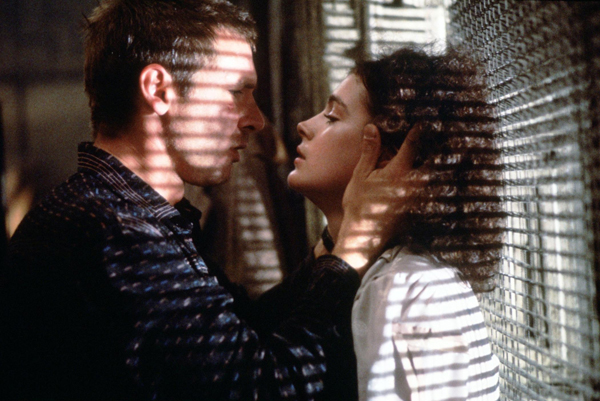
But then, of course, we wouldn’t have a movie.
Another problem with the replicants is that they only last four years –but no one – not the replicants or their creators – seems to readily know the expiration dates. Given that the replicants are used for dangerous off-world work wouldn’t it be prudent to know when they “die”? After all wouldn’t it be a disaster to send replicants on a mission and have them start expiring halfway through?
Deckard is assigned to kill four replicants that murdered a shuttle full of people and now are hiding out in LA. His investigation is riddled with holes and convenient consequences that only happen in movie scripts (he finds a tiny snake scale in the bathroom tub of an old haunt which lead him, of course, to a stripper who uses a snake in her act. She happens to be one of the replicants). He even calls them at their secret hideout and… they answer the phone.
We were also amazed at how Deckard never ever calls for back-up – even when he finally locates the replicants’ hide-out and knows he will be up against two super powerful androids that have already murdered more than 20 people.
“Blade Runner” wants to be a film about the definition of humanity – an action flick with a philosophy. But it fails in both aspects. It spends too little time exploring the idea of manufactured life being real life because the characters don’t really care about the answer. And the action sequences aren’t even as good as the average fare on TV.
7 Really Creepy Ghost Movies here
Fantastically Bad Cinema: "3:10 to Yuma"
Labels: Bad-Cinema, Blade Runner, Movies, Science Fiction
StumbleUpon |
Digg |
del.icio.us |
Reddit |
Technorati |
E-mail

 RSS Feed
]saddlebrown]tan]maroon](],](])us.st11.yimg.com/us.st.yimg.com/I/getfishy_1912_2002960]Fishboy]black],]1]10]3]1]1]1]1]1]1]1]1]1],](](]papayawhip])])]DaRK^20PaRTY^20ReVIEW]^3A^3ALiterate^20Blather^3A^3A],](](],](]maroon](](](]brown](],](]maroon](](](],]60]10],](](]^23F5ECE1])])]maroon]0.5]0],](](]^23F5ECE1])])]maroon]^23F5ECE1])])]^23666]16]maroon]maroon],](](]maroon](],](]^23333]^238C4614]tan],](](]^23F5ECE1])])],](](]^23F5ECE1])])],](](]^23F5ECE1])])],](]maroon]maroon]15]3]23]18]maroon],](](],](],](](],](]black](](](],](](](],]black](](](],](](]^23333](](](](](],]^2336F]^23333](],](]Posted^20by^20^24AUTH^20at^20^24TIME.]36],](](]black])])]^23F5ECE1])])]^23666]16]maroon]maroon],](](]maroon](],](]^23333]^238C4614]tan]Contributors]]]^24PROFILE]]]DaRK^20PaRTY^20LiNKS]]]The^20Ambrose^20Bierce^20Site])donswaim.com/]Ambrose^20Bierce]Ironic^20Times])www.ironictimes.com/index.html]Ironic^20Times]Gallery^20Voyer])www.voy-art.com/]Gallery^20Voyer]Tintinologist])www.tintinologist.org/]Tintin]Arcanum^20Cafe])www.arcanumcafe.com/]Arcanum^20Cafe]LADA^20-^20Protect^20our^20Kids])da.co.la.ca.us/pok/poklist.htm]POK^20List]Tom^20Caron^20-^20Boston.com])www.boston.com/sports/nesn/aboutus/onair/tomcaron/]TC]The^20Captain^20Humphreys^20Project])www.captainhumphreys.com/]Captain^20Humphreys]Torpedo^20Design])www.torpedodesign.com/]Torpedo^20Design]^3Cimg^20src^3D^22)us.st11.yimg.com/us.st.yimg.com/I/getfishy_1912_2002960^22^20alt^3D^22Fishboy^22^20style^3D^22border^3A^201px^20none^20black^3B^22^20/^3E])www.fishboy.com/]Fishboy]Etc]]]^3Cimg^20src^3D^22)psyc.horm.org/barimg/bar_psycho.png^22^20width^3D^2280^22^20height^3D^2215^22^20alt^3D^22PsycHo^3A^20Free^20Template^20Generator^22^20style^3D^22border^3A^200px^20solid^20black^22^20/^3E]^24PSYCHO]PsycHo^3A^20Free^20Template^20Generator]^3Cimg^20src^3D^22)psyc.horm.org/barimg/bar_firefox.png^22^20width^3D^2280^22^20height^3D^2215^22^20alt^3D^22Get^20FireFox^21^22^20style^3D^22border^3A^200px^20solid^20black^22^20/^3E])www.mozilla.org/products/firefox/]Get^20Firefox^21]^3Cimg^20src^3D^22)psyc.horm.org/barimg/bar_xhtml.png^22^20width^3D^2280^22^20height^3D^2215^22^20alt^3D^22XHTML^20Validator^22^20style^3D^22border^3A^200px^20solid^20black^22^20/^3E])validator.w3.org/check/referer]XHTML^20Validator]Recent^20Posts]]]^24RECENT]^20]]Archive]]]^24ARCHIVE]^20]]ADVERTISEMENTS]]]^20]]^26^2361470^3BPsycHo})


This work is licensed under a Creative Commons Attribution-No Derivative Works 3.0 License.
The Template is generated via PsycHo and is Licensed.